Thursday, 23 March 2023

Major Landmark Sponsorship of Tennis

This year Landmark Planning are sponsoring the Carisbrooke Tennis Club of Leicester team in the National Club League.


This is the premier team event for tennis clubs in the U.K. where the best compete in 6 regions, before a grand final weekend 8th to 10th September, this year in Bournemouth. It is the top 8 teams in the country that then reach the national finals. Carisbrooke have made the national finals in three of the last five years, finishing between 4th and 6th each time. With Landmark’s sponsorship the team will be hoping to go even further; recognising that securing a top two slot will be difficult, as the London teams attract top 100 in the world players in the singles and top 10 in doubles.


Leicester’s region encompasses the whole Midlands from Lincoln, as far as Cardiff (who have a very strong team).


In the meantime, the first home match is Sunday 2nd April at 1pm against Warwick, who are no muppets. The team will need a good performance for victory. The high quality of the tennis matches the standard of the outside courts at Wimbledon, but can be watched for free, at Carisbrooke Tennis Club on Carisbrooke Road, Leicester (access from Kenwood Road). Food and entertainment will be laid on. This is a wonderful opportunity to watch professional tennis close up at no cost.


This is our coach, Jack Simpson ‘modelling’ the club’s new kit. 


As Jack says: we are going to give this national championship a real good go this year and try and achieve our best ever performance against all the best clubs in the country.


Jack is wearing a very good quality ‘Yonex’ shirt with the club’s logo front and back.


Team shirts are available for £15 until June 30th. After then the price will be at cost: £20. This will also be the price if you want a second one. They are available in three sizes: medium, large and extra large, order via Landmark Planning (0116 2856110) or email Sam: sc@landmarkplanning.co.uk.


Watch this space for updates on how the team progresses.

Monday, 13 February 2023

Tribute to Dr Adrian Weston MBE (Friend of New Walk) 1935–2022

This is what should be a beautiful sweet gum (Liquidambar Styraciflua) planted by Friends of New Walk at the entrance of the Oval public space to celebrate the life of one of our most distinguished Trustees, Dr Adrian Weston MBE (20. 2022). The tree has a lovely shape and a wonderful show of colour in its leaves in autumn. And thank you to Leicester City Council’s Dave Jones Trees & Woodlands Manager for making it possible so quickly and efficiently.

People will probably most remember Adrian as senior partner of the Harvey Ingram LLP (15 years ago the largest law firm in the Leicester, now part of Shakespeares) and a member of the Leicester University Council for 10 years. He was also, however, an all round good egg.

A Leicestershire native, educated at schools in Thringstone and Ratcliffe on the Wreake, he spent two years in the Royal Air Force as a Pilot Officer in Fighter Control, mostly in Germany, where the RAF played a central role in the Cold War. Deciding that his future career lay in law, he took a Masters in Jurisprudence at Queens College, Oxford where his lifelong enthusiasm for sport developed into a passion for hockey.


In 1958 he became an articled clerk with a Leicester firm of solicitors, Harvey Clarke & Adams, where he stayed for 41 years, eventually retiring as Senior Partner at what had by then become Harvey Ingram LLP.

He served as non-executive director of Atkinson Design Associates Ltd, Pensions Bank Ltd, Everards Brewery Ltd and Primalux Ltd and was a member of the RAF Club. He was a Governor of Leicester High School for Girls and Ratcliffe College, serving for seven years as Chairman of Governors at the latter.

A keen sportsman, he was a member of the Leicestershire Golf Club and Vice-President of the Leicestershire County Cricket Club. But his passion was always for hockey. He served as Captain and Secretary of the Leicestershire County Hockey Association in the 1960s and then as Vice-President for 34 years. He was also Vice-President of the Midland Counties Hockey Association and Executive Chairman of the English Hockey Association. In addition to all this, he served sequentially as Chairman of first Leicester Sports and Recreation Advisory Council and then Leicestershire Sports and Recreation Advisory Council.

In 2017 he generously commissioned and donated to the University the stainless steel sculpture ‘Adagio’ which stands in Centenary Square. The sculpture by John Sydney Carter, based around elements of brass musical instruments, was commissioned in memory of Adrian's wife Bridget, who passed away in 2014 and who had been a keen supporter of Sir Bob Burgess’ work to add sculptures to campus.

Adrian served as a Trustee of the Friends of New Walk for over 20 years. One of his main foci was the provision of works of art on the Walk. He was the driving force behind the Clicker, the Clothier and the Writers Pavement, securing both the sponsorship and the design. His last project was ‘the Nib’ to celebrate Leicester’s authors with a vertical feature in New Walk’s latest public space in front of Mattioli Woods offices. As Trustees we are currently working hard to deliver his final project.

Friday, 20 January 2023

Apprenticeships

The age demographic problem in the construction industry has accelerated.

For anyone prepared to listen I have been banging on for years of the greater value of apprentices and apprentice training.


For thirty years or more both the major political parties have seen it as a top priority to show how they are educating our young people and giving opportunities to particularly students from poorer backgrounds. Their objective has been to get as many children as possible on full time education university courses. The target, I believe, was usually c. 50%.


As a consequence, the university sector expanded massively. It has become an over large industry, with many of the bad sides of an overgrown industry emerging. Quality goes down and the outputs are much more geared to what the industry wants rather than the end user. So in the case of universities, it is far more profitable to have a 100 students in a lecture hall with one lecturer talking about American studies, compared with say 1 staff for 10 students in subjects, which are technical such as architecture or biochemistry that may be much more of a benefit to our society and economy in the future. But require greater staff input.


This subject is so pertinent to many others as well. As David Smith (who has spoken in Leicester a few times) put it so succinctly in his Sunday Times Business Section column last week: We need to raise our game. Our real weakness in real wages is driven by no improvements in productivity in the last 15 years. Hardly earth shattering, but he identifies three main reasons of which the first is lack of skills in our work force. Secondly, investment in business is down and well below pre-pandemic levels, which were low anyway. The final area he identifies is a proper infrastructure strategy and investment in it.

I was recently sent an article on a Construction Economic Overview (thanks Chris Leeson) by Professor Noble Francis. Like elsewhere, Francis particularly points to the industry’s skills shortage and highlights the loss of nearly 250,000 workers in the industry in the last three years, with the largest losses in the age range 45 to 59. He suggests that the age demographic problem has accelerated in that time period. Because younger EC workers can no longer gain so easy access to the UK, the long-term structural problem in the UK construction industry is coming much earlier and indeed is upon us now.


We therefore have a perfect storm. We are still not encouraging anything like enough of our youngsters into industries we need. Construction is just one of many. And it is going to get worse, not better. Three years ago, when I was looking for an apprenticeship for my son,  I was meeting the comment we don’t do training, we prefer to take people fully trained. Mercifully not every company is like that and he secured a place with a great firm. Most are not so lucky.


As a society we have got to do better. I implore those in a position of employing people to do more. My experience and I know of others, such as Corporate Architecture, is that they get better workers who know what is required to be effective in the work place if their tertiary education has run in parallel with solid employment. That is an apprenticeship. There may be some short-term pain, but in the long run it has to be better for your company and UK PLC.

Monday, 7 November 2022

Are Electric Cars a Mirage

I fully appreciate that electric cars seem to be considered the future by so many people, commercial companies, Governments etc. This is by both legislation (eg UK all new cars must have electric propulsion by 2030) and the choice of companies, such as Jaguar, who are committed by research and investment to retire the internal combustion engine in favour of electric motors within the next few years.


I am just not convinced that electric is the future. Charging will always be an issue. In our cities two thirds of homes typically have no off road parking and how does secure charging work with on street parking in residential areas, where owners consistently wrestle for on street parking space. Recharging on long journeys will surely become a nightmare with literally thousands of vehicles potentially swamping limited space motorway service areas and the like. The infrastructure or the energy output may just not be there. Is there capacity in the national grid to support the increased demand?


Batteries production consumes considerable energy and along with transport to centres of manufacture, potentially creates more emissions. The essential mining and use of scarce minerals, which can be non recyclable and controlled by a limited number of regimes must present further difficulties in the future, as electric car production is ramped up. Moreover, as the batteries have a limited life (typically 7–8 years I believe?), renewing them in existing vehicles is likely to be extremely expensive, which must compromise used car values and by direct consequence the attractiveness of laying out the substantial figures to buy a new vehicle by consumers. Electric cars themselves are more complex then traditional motors, which drives up maintenance costs, because they require greater technical expertise. Will depreciation and maintenance costs be a killer to demand?

I just don’t get the obsession with electric cars, but I am fully prepared to admit I could be wrong. Can anyone address these very substantive concerns for me?

If we accept that fossil fuel solutions should be condemned to history what are the alternatives? I fully accept that research into alternative technologies, such as hydrogen, nitrogen and possibly hybrid fuels is well behind electric, but they are happening. Although there is an argument that time is short and have we enough time to properly develop these alternatives? In Leicestershire we have one of the main UK research centres into opportunities at MIRA. To me, with a rather superficial technical knowledge, they potentially offer solutions to the issues with electric as I see it.

I would welcome any reaction to these observations, as I have really never read much criticism of electric vehicles. In my mind I have a feeling that we are all susceptible to group think on this issue: electric propulsion is good, full stop. Is electric fully capable of replacing fossil fuels in the real world. Or am I completely wrong? If so please tell me, as I along with others, I know, are not convinced and uncertain customers do not make electric car purchases unless they have to. This will slow a revolution in moving away from vehicles that use fossil fuels and by direct impact further global warming.

Wednesday, 26 October 2022

Housing at the Parcel Yard

“A lively group of about 70 development professionals debated “Housing” at the Parcel Yard last week as part of the Love Architecture festival under the title of Quantity, Quality & Cost.
 
Grant Butterworth, Clare Bowman, Peter Brown and myself attempted to resolve a pathway through an almost impossible conundrum of trying to get the amount of housing we need to a quality standard not so far achieved in the main at a cost that is affordable. And in the context of a declining GDP, an energy crisis and a political context that changes seemingly daily.
 
Grant provided the context of both history, current targets - including arbitrary imposed ones on the major cities (plus 35%) – and the possible / likely abolition of Stalinist targets. Well clarity there then! What stood out for me that was that while targets of 300,000 homes plus have been met back in the 50s and 60’s this was only in the context of major public housing build. This I can’t see returning anytime soon. En passant Leicester will publish its new Regulation 19 Local Plan any day.


Clare, from her experience as an architect then demonstrated what she saw as the route to comprehensive sustainable development with both good layout design, but also investment in fabric first and renewables to get to or close to Passive Haus standards. And she demonstrated her comprehensive model in relation to some schemes, recognising again that initial costs were significantly high. Her work, in distilling core sustainability criteria into a checklist has informed and assisted many built schemes. Clare noted that some of the interventions we can do are however relatively cheaper and have long lasting impacts, predominantly in the use of trees for solar shade, air quality and the ability to assist in cooling our buildings
 
Peter Brown illustrated his review of cost and design in relation to his work on two different local schemes of totally different scales. What was interesting as well is the relative cost of land to build cost probably around 70%. If you assume a build cost of say £140 per sq. ft per a standard two storey house with 12/13 houses an acre, you can see what an impact much lower land prices compared with nearing £1m an acre would have on the opportunities to keep house prices down but invest much more in the initial capital cost of fabric first and renewables in a more sustainable house. Peter commented that whilst some enlightened developers are willing to engage in proactive design to improve our built environment, the majority were meeting the targets required of them out of an obligation rather than necessarily forward thinking. At least the debate is very much on the table, and as an industry together we are turning in the right direction.
 
The discussion attempted to draw these different strands together and in fact highlighted the broader conundrum related to quantity, quality and cost. One developer in the audience remarked that since the pandemic his build costs had risen c.40% and however much he tried to do the ‘right thing’ the cost inflation at a time of rising living costs and certainly mortgage rates meant that anything above current Building Regulation standards was optimistic. (It appeared generally accepted by the audience that the only way to drive standards was by national regulations). Local initiatives would never effect substantive national change, but would also make a planning process even more complex with supervision by planning officers with limited or no build technology inappropriate.
 
As Paul Collins pointed out, the elephant in the room is land prices, which are such a substantive part of the whole cost of acquiring property. Reduce that dramatically and you may have a solution, although successive Governments have tried about 5 times since the second World War to capture that value with a singular lack of success. And in the current febrile political world I cannot see much progress being made on this for many years.
 
Overall an enlightening evening so thank you to the speakers and contributors for educating and entertaining us.”

Monday, 12 September 2022

Housing: Quantity, Quality and Cost


If this isn’t a subject for our times, I don’t know what is. I hope you will be able to come to this early evening seminar in the pub.


We have the lingering Corvid crisis (impacts and costs); a war in Ukraine; and an energy crisis. But what we have also had for many years are fundamental problems with one of the basics of living, shelter. In other words housing.


Not enough; poor quality in many regards; and, cost (both capital and running costs). And, of course, the current prominent issues above have both compounded the problems regard housing, but also highlighted particular aspects, in particular energy provision.


In what has de facto become our annual planning debate in October (this year Wednesday 19th at the Parcel Yard, Leicester) we look at housing from three specific perspectives: quantity, quality and cost.


To do that we have three speakers who will each focus on one aspect, but with a nod to the others. So that in the ensuing debate: either immediately after the talks or in the bar later; hopefully relevant connections will be made between these related aspects.


Grant Butterworth (LCC Head of Planning) will look at the current debate of where the quantity of new housing required will go in the next 20 years in Leicestershire and how it will be split between the City and Districts.


Peter Brown (Director of Housing SGP) will look at the quality of the provision in place making terms.


Clare Bowman (Sustainability Adviser, Lecturer and winner RHS Chelsea Flower Show 2021 Designer Gold Medal Winner - The Biophilic Classroom) will look at the sustainability of the specific housing product, referencing the cost in both capital and operational terms.


All this should provoke a lively debate: if not it won’t be for the lack of trying!

Wednesday, 13 July 2022

Writers Pavement unveiled in Leicester City Centre

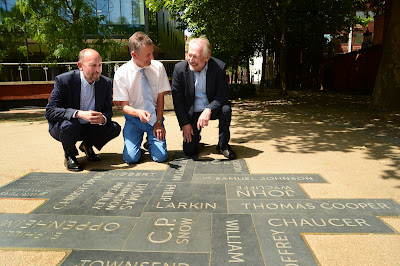
Pictured at last week’s unveiling of Leicester’s latest street art installation “The Writers Pavement” are Donald Kerr Chief Executive, Cambridge & Counties Bank, Peter Wilkinson (also Chair, Friends of New Walk) and Sir Peter Soulsby, City Mayor Leicester (L to R).


Funded entirely by the Bank, the Writers Pavement celebrates the contribution to literature by authors associated with Leicester. It is the latest in a series of public art works organised by the Friends of New Walk Charity. These include the Clicker, the Concerto and the Clothier, all within the vicinity of New Walk, complementing the extensive public investment in Leicester’s streets and spaces this century. Each piece has been backed through generous contributions by local businesses and individuals based in the New Walk area, who are keen to enhance Leicester’s unique traffic free walkway, initially laid out 230 years ago in 1785. (For more information on the Friends of New Walk Charity (see https://www.friendsofnewwalk.com) With then emergence of electric bikes and scooters this traffic free nature is becoming harder to maintain, but it is still the delightful tree lined perambulation through the heart of the City.


The Writers Pavement has been laid out in granite in the semi-circular space at the northern end of New Walk, in front of the Mattioli Woods office building. Authors celebrated range from the historic, Geoffrey Chaucer, to Joe Orton, Sue Townsend of Adrian Mole fame and C.P. Snow who actually based one of his novels in the New Walk area.


Peter Wilkinson said “I cant thank Cambridge & Counties Bank enough for their commitment to promoting public art in the City and specifically New Walk”. Donald Kerr, CEO Cambridge & Counties Bank, responded “It’s part of our commitment to our home City of Leicester and it’s our pleasure to support the enhancement of the City centre and particularly New Walk where our head office is based.