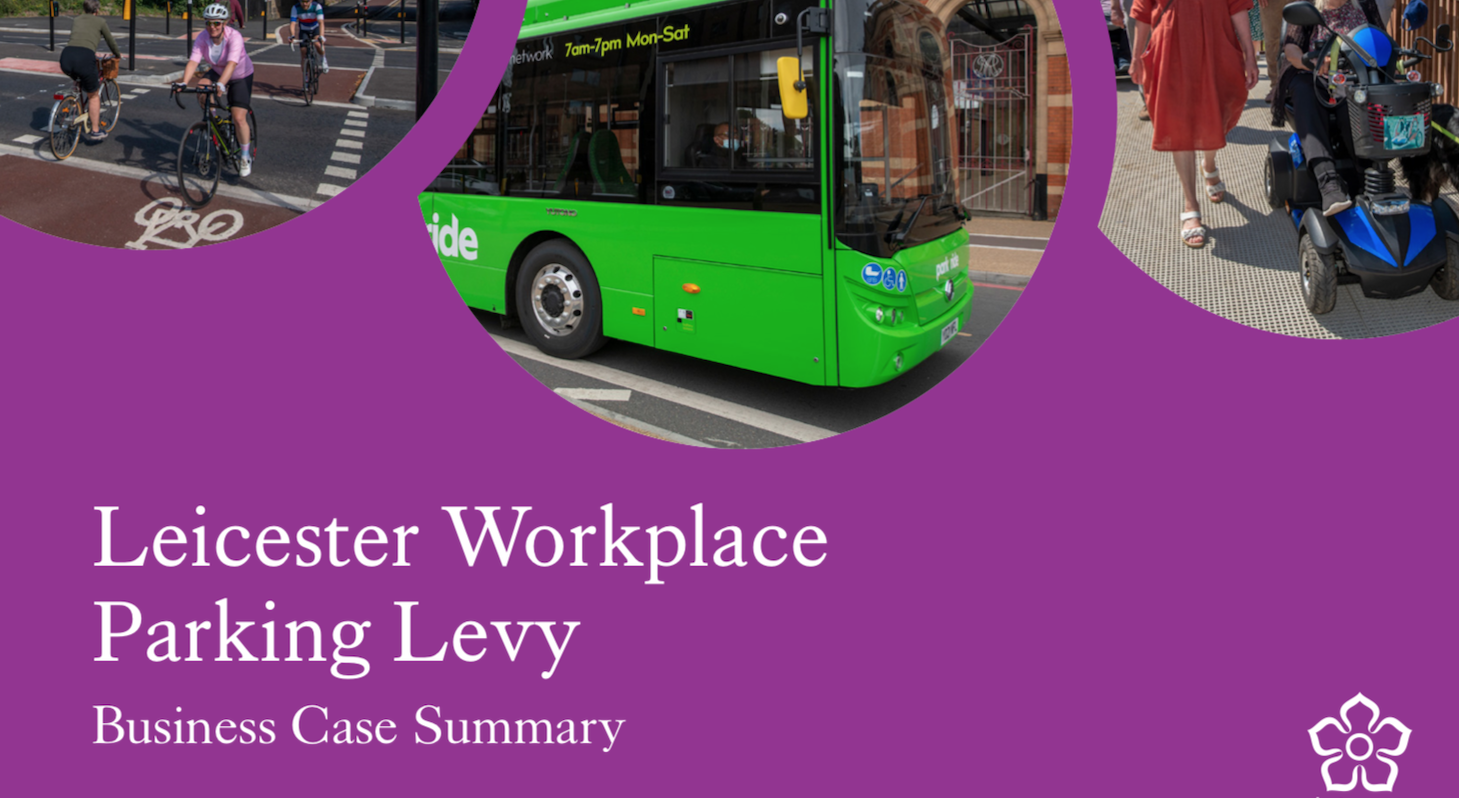
Many observations have been made about Leicester’s proposed WPL.
Tuesday, 1 March 2022
Leicester Work Place Parking Levy
Tuesday, 25 January 2022
Empirical Evidence Strengthens Planning Arguments re Sustainability.
This blog is a summary of an absolutely excellent 25 page article in JPEL Occasional Papers 48 2021 Issue 13 by Nicholas Boys Smith. Read it if you can, as it deserves a wider audience. While a lot of what is written is intuitive; very importantly it takes a number of qualitative issues, such as green is good for you and then sets out the results of empirical studies that confirm these hypotheses in a quantitative way.
The paper has 4 key points: good design is not subjective; the housing market is over concentrated with insufficient self and community build; use design codes; and, re-use older places and buildings.
To give two examples on good design:
Street trees are as close to a “no-regrets’ move as you will get. I have been forced to take out street trees on major planning applications, as the highway authority objected on safety and maintenance grounds. The key determinant of how fast we drive: is how safe the driver feels. Studies show that speeds are typically reduced by c. 7% where such trees are present and vehicle crashes reduced by between 5 and 20%. Moreover they improve air quality and moderate heat. Studies show people are also healthier in such environments and even drug prescriptions are reduced.
Facades Matter. Active frontages strengthen social ties, increase natural surveillance, improve sociability and increase the propensity to walk and therefore take exercise. Mixed–use land uses in one study showed that those people living in such areas used non motorised modes 12.2% of the time compared with 3.9% in single use communities. Modest semi public front gardens encourage neighbourliness. For example, one Danish study showed that in two parallel streets one with and one without front gardens 21 times more activity took place in those streets with front gardens.
The article goes on to really lambast the British planning approval system in lacking certainty, so the risks for developers up front are massive and costly. This has affected house prices, but also pushes the small builder and self-builder out of the market. Small builders only build 12% of our stock now (lower than anywhere else in Europe), yet even 30 years ago it was 40% in Britain. This lack of choice leads to too many poor homes and not enough of them.
The article goes on to review sustainability and the green agenda. The thermal efficiency of new buildings and the location of (and transport to) places has been our focus. But there are three other factors which will influence the lifelong carbon footprint of new places and so far have been insufficiently considered: the form, shape and height of buildings; longevity (resilience and flexibility of design); and, the energy required for some materials.
So for example carbon emissions more than doubled going from 'low rise' to 'high rise’. The largest producer of waste in the U.K. is demolition and construction (24%). A new build two-bedroom house uses the equivalent of 80 tonnes of CO2; refurbishment uses 8 tonnes. Adaptability and flexibility is critically important. Materials also matter. Buildings using stone brick and wood, but not cement, fibre glass or aluminium have much lower embodied carbon.
In other words we have a long way to go in providing quality housing in beautiful, neighbourly and life enhancing places. And also a long way to go in planning buildings that least compromise our planet.
Friday, 10 December 2021
Planning: A Cri de Coeur
Despite a frequent commentary that working from home has improved staff satisfaction and not compromised efficiency I just don’t buy it.
My own view is very much the converse with observed efficiency (measured in the private sector by staff charge out hours) that could be down as much as 25%. And this parallels the studies of, for example, Goldman Sachs.
I don’t deny for a minute that Teams & Zoom have a place and are a welcome addition to a working armoury. They can be ideal for well structured meetings, with an effective Chair among people who know each other; and, for whom there are significant disbenefits of travel. But for developing three dimensional relationships, team problem solving and mentoring junior staff forget it. And that is ignoring the potential mental health disbenefits of isolation. A hybrid model can work, but to maintain team bonding the balance should be well in favour of office working in my opinion.
A lot of my work involves liaising with local authority Planning Departments - after all my principal task is getting planning permission for clients and there is a monopoly supplier in each District, so I have nowhere else to go. And here the delays are mountainous. I think it can be attributed to a number of reasons:
A significant increase in workload, especially from house extensions, as people need more space working from home and with not spending money on other things like holidays and going out as they can’t or don’t want to. They have more money to develop their home.
Development is divisive. More people work from home and have more time and knowledge about neighbours' development. And then they complain to the Planning Authority. The same goes for local communities with greater use of social media platforms to complain. Covid has been a petri dish for key board warriors – its all too easy.This creates more enforcement work for Council Planning Departments.
The scale of development needed to support the Government’s growth agenda means many councils, especially in the big cities and the South-East, have been expected to plan for a much increased number of dwellings. Equally, the complexity of the work load has expanded. Currently, the largest growth area is biodiversity, with most of my major schemes (and sometimes even one house proposals) being held up while we wrestle with greater red lists for protection to accommodating a 10% gain, which is already being implemented by many Councils.
The increased importance on design (which I warmly applaud) means that the necessary skills are insufficient in current Council Planning departments. And this brings more work as well. Difficulties in getting materials, as another byproduct of Covid, has led to more changing and therefore more repeated discharge of conditions applications.Using Teams for Design Workshops or Design Review Panels is really not great.
Planning departments are income centres with many Councils over the last few years forced to economise on both staff and training (on matters as diverse as design and biodiversity), so have to make money from fees to support other parts of the Councils' work. This leads to lower morale and poorer trained planning staff, who can rarely go on courses. A self perpetuating downward spiral. Chickens particularly come home to roost in a Covid world, where isolation means on the job training and team building are severely compromised. How can anyone undertake a proper induction remotely?
A further impact in some authorities is a deteriorating relationship between officers and Councillors. It is not unheard of for Councillors to not have inhibitions about pressurising officers to change their professional recommendations. You don’t have to have too many of those instances for morale to slump further and encourage changes of jobs or early retirement. And this in a context where we have not trained enough planners anyway over the years. Early retirement in particular, means the most experienced leave, which further reduces efficiencies and leaves gaps in the training of juniors, who do not have sufficient mentors.
Fear of making mistakes in this environment, but also at Planning Inspectorate decision making level, means it is easier and quicker to refuse an application. It is much harder to be blamed for a bad decision that is actually built, while decision making targets can be more easily met. For example, I would wager that the quality of planning appeal submissions has improved, but the success rate for applicants has virtually consistently declined in recent years.
In planning the imperative is (or should be) to make a balanced judgement. The Planning Balance can be a very hard exercise. One is nearly always evaluating a wide variety of qualitative factors (not quantitive with a measurable numerical calculation). This means you need the wisdom of Solomon. And for that you need experienced, well trained and motivated staff on both the public and private sides. As a society we are not getting the quality of planning professionals we either need or deserve, nor is the public service being adequately funded. As most developments will be around in one form or another for a number of generations this must be rectified as soon as possible to be sustainable.
Thursday, 4 November 2021
“Reports of my death are greatly exaggerated”
This was the opening quote on a night at The Depot, Leicester discussing “The Future of City Centres” at the latest Landmark Planning organised free seminar for property professionals.

Monday, 4 October 2021
The Future of City Centres
This pandemic has bot temporarily (and it is argued to a lesser degree) fundamentally altered many land use patterns in the UK.
City centres will be one to be significantly affected by Covid. But city centres are the heart of our communities. And a failing heart will completely compromise the heath of bot our own bodies and City centres.
What is and what can be done?
Landmark Planning have organised a free seminar as part of the Love Architecture Festival of LSRA (Leicestershire & Rutland Society of Architects) on Wednesday October 20th at 6pm at the Depot, Rutland Street, Leicester to consider this burning question “The Future of our City Centres” of out times. There will be 5 presentations from 5 different perspectives. There will be no pretention at offering complete answers – this is not realistic for such a multi-faceted issue – instead the intention is to offer some thought provoking ideas and opportunities that could be seized to help centres fight back. What it will do is show how some individuals are reacting to maintain City centres as the heart of our communities.
To attend contact us on 0116 2856110 or sc@landmarkplanning.co.uk. But be quick it is bound to be a sell out.
Tuesday, 14 September 2021
Walsall’s very special reason for green belt housing.
Last week I sat through a Walsall Planning Committee meeting. A long discussion was held over the officer’s recommendation for refusal tor the allocation of a site for up to 150 houses on green belt land. The site is not allocated for development, not even in the emerging Black Country Local Plan, currently out to public consultation.
The Black Country Green Belt
The Councillors were struggling to find a reason to approve an outline application. This was especially the case as the site could not be classed as previously developed land. As anti-social activity had been witnessed on the site, the Chair hit upon the idea that crime and fear of crime can be a material planning consideration. Therefore this can be used as the reason for accepting the proposal.
So the proposal was accepted by the Members, seemingly tor this reason only. What the Chair had done was conflate a material planning consideration with “very special circumstances.” Perhaps an easy trap for a non professional to fall into? Or was it because the land was owned by the Council?
Good luck with convincing the Secretary of State, as the application will have to be referred. And if acceptable lets just encourage anti-social behaviour and we can all get green belt land developed for housing?